Warm White vs Multicolor Solar Christmas Lights: Which to Choose
Warm white or multicolor solar Christmas lights? Compare color temperature, efficiency, LEDs per panel and run times, plus where each look works best.
We may earn a commission when you buy through links on this page. Listings and prices come from our partners and change often. Learn more.
Choose warm white solar lights for a classic, golden glow that suits brick, wood and evergreen trees, and that is easy to match. Choose multicolor for a playful look on trees and bushes, but check how many LEDs the panel supports, since some makers allow fewer LEDs per panel when red ones are included.
Both looks are easy to find in solar sets. The differences that matter on a solar string are efficiency, how many LEDs one panel can run, and how well the set matches the rest of your display. For every other buying factor, see our guide to the best solar Christmas lights.
Warm white vs multicolor at a glance
| Attribute | Warm white | Multicolor | Source |
|---|---|---|---|
| Color | Around 2,700 K, golden white | Fixed red, green, blue and other colors | DOE |
| LED efficiency | Fixed white LEDs beat color-mixing systems | Green LEDs are less efficient than white | DOE |
| LEDs one panel can run (one maker) | Up to 1,200 | 400 if any red LEDs are used | Environmental Lights |
| Rated run time examples | 8 to 10 hours (Brightown 33 ft fairy lights) | 16+ hours (Brightown 800 LED multicolor set) | Brightown |
| Lighting modes | Commonly 8 | Commonly 8 | Brightown |
Run time examples come from different products with different panels and batteries. They show that color does not decide run time on its own.
What does “warm white” mean on solar lights?
White LEDs are described by color temperature in kelvin (K). Lower numbers look warmer and more golden. The U.S. Department of Energy describes warm white LEDs as usually around 2,700 K, and cool white as about 5,000 to 6,500 K. It also notes that dim-to-warm products are designed for 2,700 to 3,000 K at full output.
Listings for solar Christmas lights often say only “warm white” without a number. If a seller does give a kelvin rating, anything near 2,700 to 3,000 K will look like classic incandescent mini lights. Ratings of 5,000 K and up fall in the DOE’s cool white range, which looks crisp and slightly blue.
What counts as multicolor?
There are two kinds, and listings do not always make the difference clear.
Fixed multicolor. Each LED has one color, and the colors repeat along the string. Some sets use a limited palette, such as Brightown’s red, green and white solar lights.
Color-changing (RGB). Each LED mixes red, green and blue to cycle through colors. The DOE notes that full-color-tunable systems may be less efficient than fixed-color white products, partly because green LEDs are lower in efficacy than white LEDs. On a solar string, where every watt-hour comes from a small panel, that trade-off is worth knowing.
Does light color change how long solar lights stay on?
Color is a smaller factor than panel size, battery capacity and LED count. The clearest evidence of color mattering comes from Environmental Lights’ commercial solar system. It allows 1,200 LEDs per solar panel, but only 400 if any red LEDs are on the run. The manual does not give the reason. It does show that a multicolor run with red may need more panels for the same length.
Consumer listings point the other way just as often. Brightown lists 8 to 10 hours for a warm white 100 LED fairy set, over 10 hours for its red, green and white set, and 16 or more hours for its multicolor set. Those are different products with different hardware, so the lesson is to compare stated run times, not colors. For more on what drives run time, read how long solar Christmas lights stay on.
Warm white and multicolor solar Christmas lights
Browse current solar Christmas lights on eBay, new condition only.
Shop solar Christmas lightsOpens eBay in a new tab. Check condition, seller feedback and returns on the listing.
Where does each color look best?
These are design suggestions, not rules.
Warm white works well for
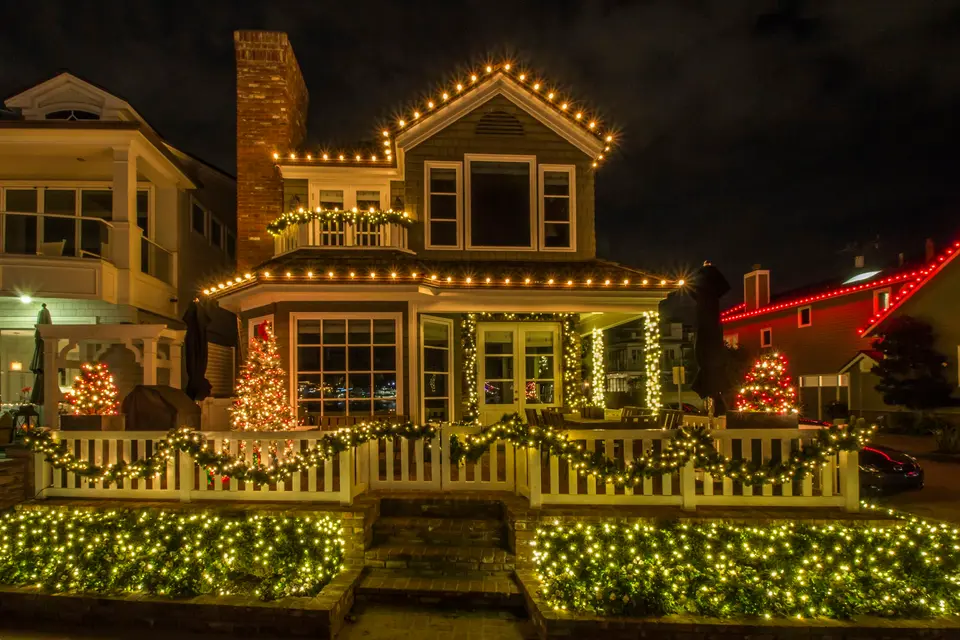
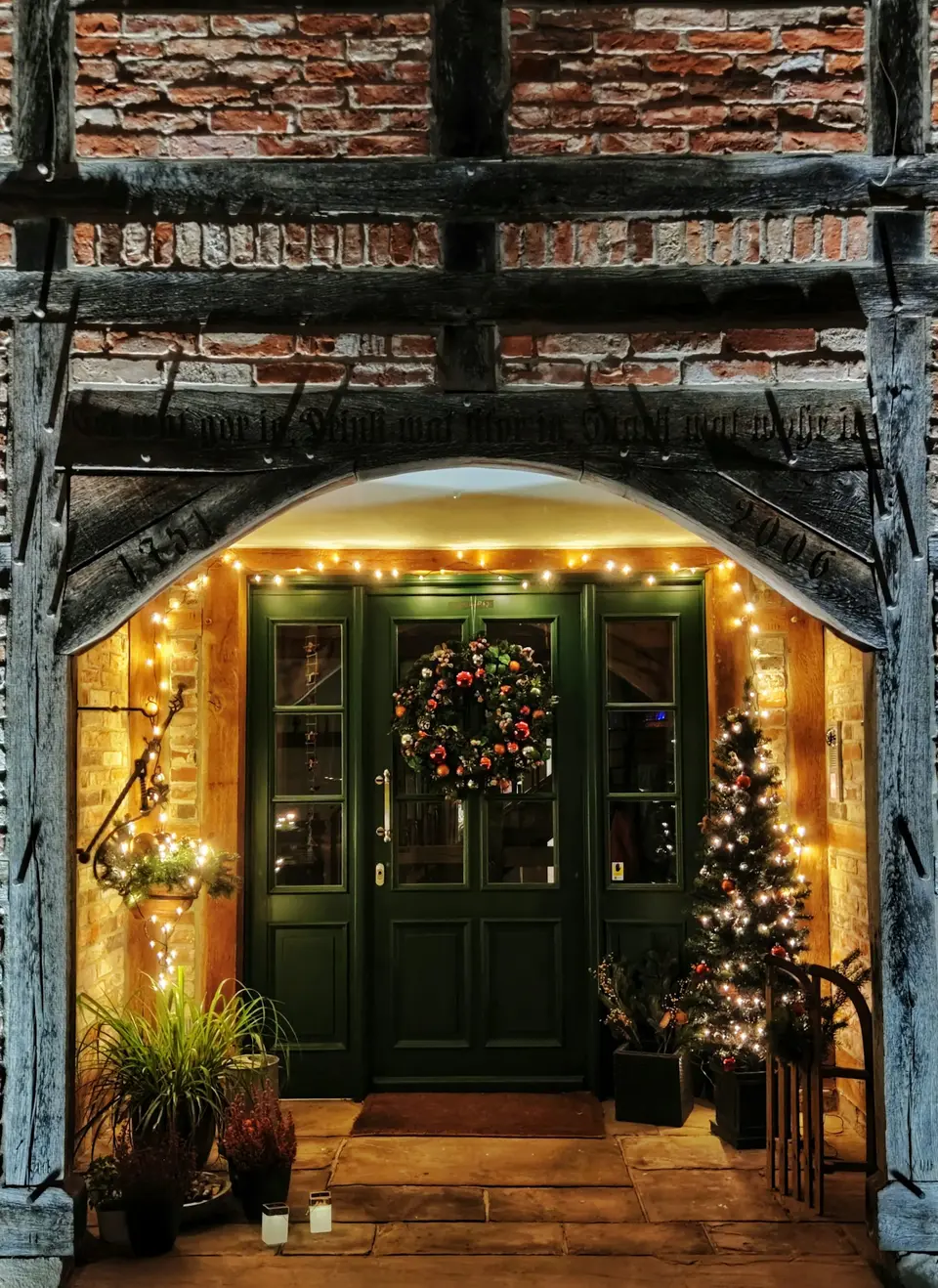
- Rooflines, porches and railings on brick, stone or wood houses.
- Outdoor evergreens, where the golden light reads as classic.
- Displays that mix solar and plug-in lights. Matching warm white is easier than matching two multicolor patterns.
- Net lights on hedges, where a single color gives a clean, even shape. See our guide to solar net lights for bushes.
Multicolor works well for
- Single trees in the yard, especially with a star on top. Our guide to solar Christmas tree lights covers strand counts.
- Family displays with inflatables or yard figures.
- Front bushes seen from the street, where color helps small lights stand out.
Tips for mixing colors in one display
- Give each zone one scheme. Warm white on the house and multicolor on the tree looks planned. Both on the same bush usually looks accidental.
- Match white to white. A cool white string next to a warm white one shows the difference clearly. If you already own plug-in lights, match their color family. Our solar vs plug-in Christmas lights comparison covers combining the two.
- Check the mode. Some solar sets start in a flashing mode; The Solar Centre’s fairy lights, for example, default to an alternating pattern. Set steady-on for a calm warm white look. Sets with memory keep that choice.
- Buy one brand per zone. “Warm white” varies between makers. Two sets from the same product line are more likely to match.
Which should you buy?
If you want one set that goes with anything, choose warm white. It is the easiest to match, and white LEDs avoid the efficiency penalty the DOE describes for green and color-mixing LEDs. If the lights are for a single tree or a children’s display, multicolor adds more fun, and a fixed multicolor set is a better choice than color-changing RGB when sun is limited. In either case, the panel, battery and rated run time matter more than the color.
Frequently asked questions
Are warm white or multicolor Christmas lights more popular?
We did not find reliable national sales data that splits the two, so we cannot say. Most solar makers offer both, and some offer red, green and white mixes as well.
Do multicolor solar lights use more battery than warm white?
Not in a way you can predict from color alone. Run time depends mainly on battery size, panel and LED count. Brightown lists 16 or more hours for a multicolor set and 8 to 10 hours for a warm white fairy set.
What Kelvin is warm white?
The DOE describes warm white LEDs as usually around 2,700 K, with dim-to-warm products designed for 2,700 to 3,000 K at full output. Lower numbers look more golden.
Can I mix warm white and multicolor lights in one display?
Yes. A common approach is to give each zone one scheme, such as warm white on the house and multicolor on a tree, rather than mixing both on one bush.
What is the difference between multicolor and color-changing solar lights?
Multicolor sets use LEDs in fixed colors. Color-changing sets mix red, green and blue light to make many colors. The DOE notes that color-mixing systems are usually less efficient than fixed white LEDs.
Sources
- Understanding LED Color-Tunable ProductsU.S. Department of Energy
- Solar LED Christmas Lights ManualEnvironmental Lights
- 33Ft 100 LED Outdoor Solar Fairy Lights, Warm WhiteBrightown
- 4 Pack Total 288ft 800 LED Solar Powered String Lights, MulticolorBrightown
- 2 Pack Total 80FT 200 LED Solar Lights with 8 Modes for Christmas DecorationBrightown
- 39 FT 100 LED Solar Powered Christmas Snowflake String LightsBrightown
- Solar Fairy Lights User GuideThe Solar Centre
Part of our guide to Best Solar Christmas Lights for Outdoors: What to Buy and Why.