Solar Christmas Pathway Lights: Spacing, Types and What to Check
How to choose solar Christmas pathway and stake lights: candy canes, festive shapes and brighter path lights, with spacing, run time and IP ratings.
We may earn a commission when you buy through links on this page. Listings and prices come from our partners and change often. Learn more.
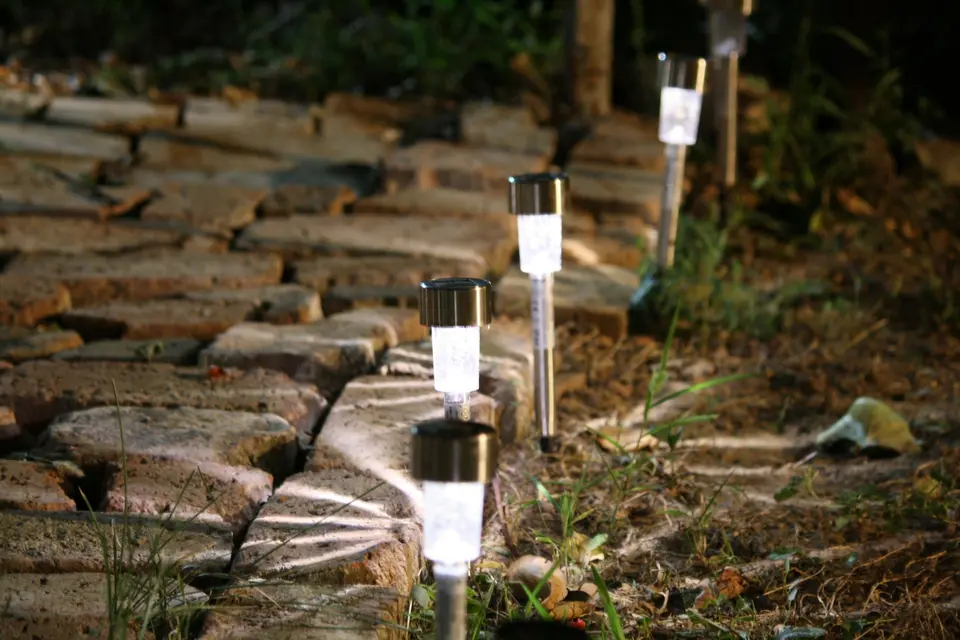
Solar Christmas pathway lights are small stake lights, often shaped like candy canes, stars or trees, that mark a walk rather than fully light it. Space them about 6 to 8 feet apart on a standard path, closer on narrow ones, and choose a brighter solar path light if you need to see your footing.
Stake lights are one of the easiest solar displays to set up, since each light carries its own small panel and there is nothing to hang. The trade-off is that each panel is tiny, so placement matters more than it does for string lights.
What matters in solar Christmas pathway lights
A few specs separate a set that glows all evening from one that fades by dinner:
- Panel on each stake or one shared panel. Individual panels let you place lights freely. A shared panel means one sunny spot powers the set.
- LED count per light. A few LEDs give a decorative glow. Dozens give usable light.
- Battery type and stated run time. Lumaz’s festive stakes, for example, use Ni-MH cells.
- Weather rating. IP65 or better for ground level, where water pools.
- Modes and memory. Useful on candy canes, less so on path lights.
How far apart should Christmas pathway lights be?
LeonLite, a landscape lighting maker, says a commonly accepted spacing for path lights is about 6 to 8 feet, depending on brightness. For narrow paths, it suggests lights along one edge only, spaced less than 5 feet apart.
For wider paths, it describes a staggered layout: a light on the right after 3 to 4 feet, then one on the left after another 3 to 4 feet, and so on.
Those figures are for real path lights. Festive stakes with only a few LEDs each usually need to be closer to form a clear line.
To work out how many stakes you need, divide the path length by your spacing and add one for the end. A 40-foot front walk lit along one side at 6-foot spacing needs about 8 stakes. Lit on both sides, or at tighter spacing for small festive stakes, the count roughly doubles, so a single 5-pack rarely covers a full walk.
| Path | Suggested layout | Source |
|---|---|---|
| Standard walkway | About 6 to 8 feet apart | LeonLite |
| Narrow path | One edge, under 5 feet apart | LeonLite |
| Wider path | Alternate sides every 3 to 4 feet | LeonLite |
Types of solar Christmas pathway lights
Candy cane stakes
Candy canes are a familiar Christmas path marker. Lumaz sells its solar candy canes as individual stakes, not linked on one cord, in 5 and 8-piece sets. It lists eight modes with memory, an IP65 rating and ABS construction, and says they are made for rain, snow and frost.
Individual stakes mean each cane needs its own patch of sun. Check your path at midday before planning the layout.
Festive shapes: stars, trees, bells and snowflakes
Mixed shapes give a more playful path. Lumaz’s 5-pack of festive stakes includes a star, tree, bell, snowflake and fawn. Each lists 5 warm white LEDs, a Ni-MH battery, a 2V 160 mAh monocrystalline panel, an 8-hour charge and 6 to 8 hours of light, with an IP65 rating.
Five LEDs per stake is a soft glow. These work as markers and decoration, not as lighting to walk by. For bigger stars on stakes or in trees, see our guide to solar star lights and tree toppers.
Brighter solar path and spot lights
If the path needs real light, pair festive stakes with brighter solar fixtures. Brightown’s solar spot path light, for example, lists 58 LEDs per light, three brightness levels (30, 60 and 100 percent) and an IP67 rating. It can go in the ground or on a wall. Brightown claims 4 hours of sunlight gives 12 to 20 hours of light, which is the maker’s own best-case figure.
Solar pathway and stake lights for Christmas
Browse current solar Christmas pathway lights on eBay, new condition only.
Shop solar Christmas pathway lightsOpens eBay in a new tab. Check condition, seller feedback and returns on the listing.
What do IP65 and IP67 mean for stake lights?
Stake lights sit at ground level, where rain splashes and puddles form. LINAK’s summary of the IP standard says IP65 means dust tight and protected against water jets. IP67 adds protection against temporary immersion up to 1 meter.
For low spots that flood after rain or snowmelt, IP67 is the safer choice. For the full comparison of IP44, IP65 and IP67, see waterproof solar Christmas lights.
Where to place solar stake lights for the best charge
Each stake’s panel needs direct sun. Paths along the north side of a house, under trees or beside tall hedges may get little winter sun, so check at midday before you set them out.
Lights4fun recommends wiping panels with a clean cloth from time to time and keeping solar lights away from street or security lighting, which can interfere with the daylight sensor. Along a front walk, that means not placing stakes right under a porch light or motion floodlight.
How long do the batteries last?
Lights4fun says rechargeable solar batteries last up to about 600 charges on average, and usually need replacing within 2 years. Before buying, check whether each stake’s battery can be replaced. Our guide to why solar Christmas lights stop working covers battery checks and other fixes.
Buying solar pathway lights on eBay
Check whether the listing states the LED count per light, the battery type, the IP rating and whether each stake has its own panel. Pack size matters for spacing: at about 6 feet apart, a 5-pack covers roughly 24 feet of path on one side. Look at seller feedback and returns, and test each stake at dusk after a full day of sun.
Related guides
- Add figures and shapes to the yard with our guide to solar Christmas yard decorations.
- See every type of solar display in our best solar Christmas lights guide.
Frequently asked questions
How far apart should solar pathway lights be?
LeonLite, a landscape lighting maker, gives about 6 to 8 feet as a common spacing. For narrow paths it suggests lights along one edge, less than 5 feet apart. Small festive stakes with only a few LEDs look better closer together.
Are solar candy cane lights bright enough to light a path?
They mark the edges of a path more than they light it. If you need to see your footing, pair them with brighter solar path lights or spotlights.
How long do solar pathway lights last each night?
It depends on the model and the sun. Lumaz lists 6 to 8 hours for its festive stakes after an 8-hour charge. Brightown claims 12 to 20 hours from 4 hours of sun for its spot path lights, which is the maker's own best-case figure.
Are solar pathway lights waterproof?
Most are rated for outdoor use. Look for IP65 (dust tight, protected against water jets) or IP67 (also protected in temporary immersion up to 1 m), which suits spots where puddles form.
Why do my solar path lights not turn on at night?
Common causes include a panel in shade, a dirty panel, a switch left off, or a nearby porch or security light confusing the sensor. Lights4fun also notes rechargeable solar batteries usually need replacing within about 2 years.
Sources
- How To Space Landscape LightsLeonLite
- 8 Modes Solar Christmas Candy Cane Lights Outdoor WaterproofLumaz
- 5-Pack Festive Shape Solar Christmas Pathway LightsLumaz
- 4Pack Solar Powered Spot Pathway Lights Outdoor Waterproof with 3 Light ModesBrightown
- What is an Ingress Protection (IP) rating and what does it mean?LINAK U.S.
- Solar Lighting FAQLights4fun
Part of our guide to Best Solar Christmas Lights for Outdoors: What to Buy and Why.